
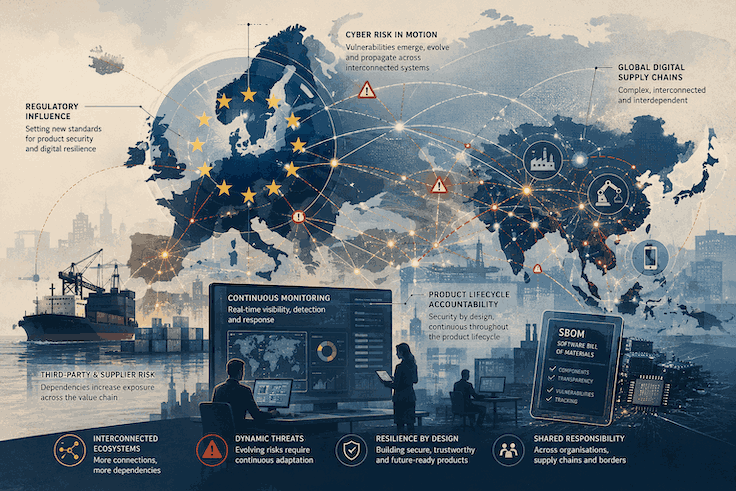
Why the EU Cyber Resilience Act Signals a Global Shift Affecting Asia and the Approach to Cyber Risk Management
For many organisations in Asia, the European Union’s Cyber Resilience Act (CRA) may appears to be a distant regulatory issue with limited relevance outside Europe.
This perception is dangerously misleading.
While the CRA is formally an EU regulation designed for the European single market, its implications extend far beyond Europe’s borders. Much like GDPR transformed global approaches to data privacy, the Cyber Resilience Act is likely to reshape how organisations around the world approach cybersecurity, software accountability, and digital risk governance.
However, the most important point is often misunderstood. The CRA is not simply another cybersecurity regulation. It represents a deeper structural shift in the philosophy of risk management itself, a transition from periodic and static approaches to continuous and dynamic risk governance.
This shift will profoundly affect organisations in Asia, particularly those integrated into global supply chains, digital ecosystems, and international markets.
The Global Spillover Effect: Why Asia Cannot Ignore the CRA
Many Asian organisations assume that because they are headquartered outside Europe, the CRA does not concern them. In reality, the globalisation of regulation rarely works that way anymore.
Today, regulations increasingly spread through market access requirements, supply chain dependencies, procurement standards, investor expectations, and contractual obligations.
The CRA is a clear example of this phenomenon. Any organisation that:
- sells connected products or digital services into the EU,
- supplies components, software, or systems to companies operating in Europe,
- or participates in global technology value chains connected to European markets,
will increasingly face pressure to align with CRA expectations.
In practice, Europe is exporting cybersecurity governance standards through economic interconnectedness. This is particularly significant for Asia because many economies in the region are deeply embedded within global manufacturing, software development, electronics, IoT, semiconductor, and digital services ecosystems.
For example:
- Asian manufacturers produce large volumes of connected devices sold globally,
- software development and outsourced digital services often involve multinational supply chains,
- and critical components integrated into European products frequently originate from Asia.
As a result, even companies with no direct presence in Europe may still find themselves indirectly subject to CRA-driven requirements through clients, distributors, integrators, and partners.
This creates a powerful spillover effect. Cybersecurity regulations are no longer confined by geography. They increasingly travel through value chains.
A New Paradigm for Cyber Risk Management
The true significance of the CRA lies not only in compliance obligations but in the new operating model it introduces for cybersecurity governance.
Under the traditional paradigm, most organisations approached cybersecurity risk through relatively static methods such as annual security reviews, periodic audits, compliance checklists, occasional penetration testing and reactive incident response.
This model reflected a world where systems changed more slowly and digital interdependencies were less complex.
That world no longer exists.
Modern organisations now operate within highly interconnected digital ecosystems characterised by continuous software updates, cloud infrastructures, third-party dependencies, open-source software components, AI-enabled systems and globally distributed supply chains.
In such an environment, vulnerabilities evolve continuously at fast speed. A product considered secure today may become vulnerable tomorrow due to newly discovered software flaws, vulnerabilities in third-party libraries, supply chain compromises, emerging attack techniques or geopolitical cyber threats.
This is why the CRA places strong emphasis on:
- continuous vulnerability monitoring,
- Software Bill of Materials (SBOMs),
- lifecycle security management,
- vulnerability reporting obligations,
- and ongoing accountability for product cybersecurity.
This marks a profound shift from viewing cybersecurity as a periodic technical exercise to treating it as a continuous governance responsibility.
The implications extend far beyond IT departments.
Cyber risk is increasingly connected with operational risk, strategic risk, supply chain risk, reputational risk, and ultimately business continuity risk.
The Challenge for Asian Organisations
This transformation creates significant challenges for many organisations across Asia. While cybersecurity maturity has improved considerably in recent years, many organisations are still operating within legacy risk paradigms:
- Compliance-driven,
- Organisational silos separating IT, cybersecurity, and enterprise risk
- Protection mindset in risk management culture.
- Reactive approaches focused on incident response
Cybersecurity often remains isolated from enterprise risk management, business strategy, procurement decisions, and operational governance.
In many cases IT teams manage cyber controls, compliance teams manage regulations, risk teams focus on enterprise reporting, while business leaders remain disconnected from the evolving cyber risk landscape.
This fragmentation becomes increasingly dangerous in a world where cyber risk is deeply interconnected with operational resilience, digital trust, market access and organisational survival.
Another major challenge is capability asymmetry. Global regulatory expectations are evolving faster than organisational capabilities. Many organisations in Asia, especially SMEs, manufacturers, distributors, and traditional enterprises undergoing digital transformation may lack:
- continuous monitoring capabilities,
- software dependency visibility,
- mature vulnerability management processes,
- integrated governance models,
- or leadership understanding of dynamic cyber risk.
The result is a widening gap between what global markets increasingly expect and what many organisations are currently prepared to deliver.
That gap represents both a major risk and a strategic vulnerability.
From Cybersecurity to Enterprise Risk Integration
One of the most important implications of the CRA is the accelerating convergence is the need to integrate cybersecurity into the broader enterprise risk management (ERM) framework. For many years, cyber risk was treated primarily as a technical problem. That approach is no longer sustainable. Today, cyber incidents can disrupt operations, supply chains, customer trust, regulatory standing, financial performance and organisational reputation simultaneously.
Cybersecurity therefore cannot remain confined within IT functions alone. Boards and senior leadership increasingly need to understand cybersecurity as part of broader organisational resilience and strategic governance.
Cybersecurity must be:
- Embedded into strategic decision-making
- Connected to business performance and resilience
- Managed as part of an integrated risk ecosystem
This requires:
- integration between cyber risk and ERM,
- stronger cross-functional collaboration,
- continuous intelligence gathering,
- and more adaptive governance systems.
The shift is philosophical as much as operational. Traditional enterprise risk management models were often designed around relatively stable environments and periodic assessment cycles. But digital ecosystems are fluid, interconnected, and continuously evolving.
Risk itself is now in motion.
This means organisations must move toward dynamic risk monitoring, adaptive governance, real-time situational awareness and continuous resilience-building.
The challenge is no longer simply preventing incidents. It is developing the organisational capability to continuously sense, interpret, adapt to, and respond to evolving threats and uncertainties.
The ARiMI Perspective: From Static Risk Management to Dynamic Risk Capability
At ARiMI, we view developments such as the Cyber Resilience Act as part of a much broader transformation affecting the future of risk management globally. The central issue is not merely compliance with a new regulation.
It is the emergence of a new reality where risks evolve continuously, interdependencies amplify vulnerabilities and traditional static approaches to risk management become increasingly insufficient.
This is why ARiMI advocates a shift toward more dynamic, integrated, and intelligence-driven approaches to risk governance. Organisations need more than technical cybersecurity controls.
They need:
- stronger risk leadership,
- greater enterprise-wide risk awareness,
- integrated governance structures,
- adaptive decision-making capabilities,
- and the ability to manage uncertainty continuously rather than periodically.
This requires rethinking risk management itself. The future belongs to organisations capable of:
- integrating cyber risk into enterprise strategy,
- connecting technology risk with business resilience,
- building cross-functional risk intelligence,
- and developing cultures that support continuous adaptation.
In this environment, risk management is not just focussing on protecting value. It increasingly becomes a capability for sustaining resilience, enabling innovation, and supporting long-term strategic performance under uncertainty.
A Strategic Inflection Point
The Cyber Resilience Act should not be viewed merely as another European regulation. It is an early signal of a larger global transformation.
The world is moving toward continuous accountability, continuous monitoring, continuous adaptation and continuous governance of digital risk.
This transformation will not remain confined to Europe. It will progressively influence:
- global supply chains,
- market expectations,
- regulatory ecosystems,
- and enterprise governance models worldwide.
Organisations that continue to manage cyber risk through fragmented, static, and compliance-oriented approaches may find themselves increasingly exposed and strategically disadvantaged.
Those that recognise this shift early and develop dynamic risk capabilities accordingly will be better positioned to strengthen resilience, maintain trust, preserve market access, and create sustainable value in an increasingly uncertain and interconnected world.
This transformation is coming. So the question is whether organisations are prepared to adapt before the gap between risk complexity and organisational capability becomes critical.
The CRA reporting obligations begin applying from 11 September 2026, with the main obligations entering into force on 11 December 2027.
There is now less time than many organisations think to get ready.
To find more about the CRA follow this link on the European commission website:
https://digital-strategy.ec.europa.eu/en/policies/cra-summary
Looking to strengthen your ERM capabilities with structure, clarity and relevance?
Join the network of professionals who have been rigorously trained and certified through ARiMI’s flagship program. Alumni come from leading organisations including AON, KPMG, SingHealth, the Ministry of Home Affairs, Changi Airport Group, Airbus and many more.
Explore ARiMI’s professional certification programs and start building the skills that matter.